Maui sits over water that drops to a thousand fathoms within a few miles of shore — blue marlin, ahi, mahi and ono country. Here's how to charter it, how to fish the shoreline like a local, and the license rule that changed in 2024.
Two things surprise visiting anglers. First, on Hawaiian sportfishing charters the catch traditionally belongs to the boat — you'll take home a generous bag of fillets, and the rest subsidizes trip prices. Second, since May 2024 non-residents 15+ need a license even to fish from shore: the Nonresident Marine Fishing License, $20/day, $40/week or $70/year, online-only at fishing.hawaii.gov (a phone screenshot counts). Most travel guides — and plenty of older local pages — still say no license is needed. That's outdated.
Charters
Boats worth booking
The 2023 fire destroyed Lahaina Harbor's fleet; the harbor's phased reopening began in December 2025 with tour boats first, so in 2026 nearly all fishing runs from Māʻalaea Harbor (~35–45 minutes) — with one very convenient exception at Māla Boat Ramp, ten minutes from the condo. FishMaui.com is the long-running local booking service with the most current picture of who's actually fishing.
UFO Fishing — the west-side boat, from Māla Boat Ramp: offshore shared trips around $449 for six hours on the Kimmy V (currently the only sportfisher working West Maui waters), plus cheaper inshore bottom trips on the Mercury — the best family pick near the condo.
Māʻalaea sport boats — Mjolnir (a 37-foot Viking launched in 2023 and one of the island's top catch boats), Steady Pressure's Jun Ken Po and Musubi, Rascal, Piper, Rod Bender, Die Hard and Action's long-range Automatic. Shared six-hour trips run roughly $375–$450 per angler; private boats $1,850–$2,100+ for six to eight hours.
Bottom fishing for families — calm-water, light-tackle, high-action morning trips: Hokua II (about $196 adult / $175 child with taxes in) and Strike Zone (~$280 angler / $100 rider). Kids from age 4 on some boats — and you generally keep the bottom fish you catch.
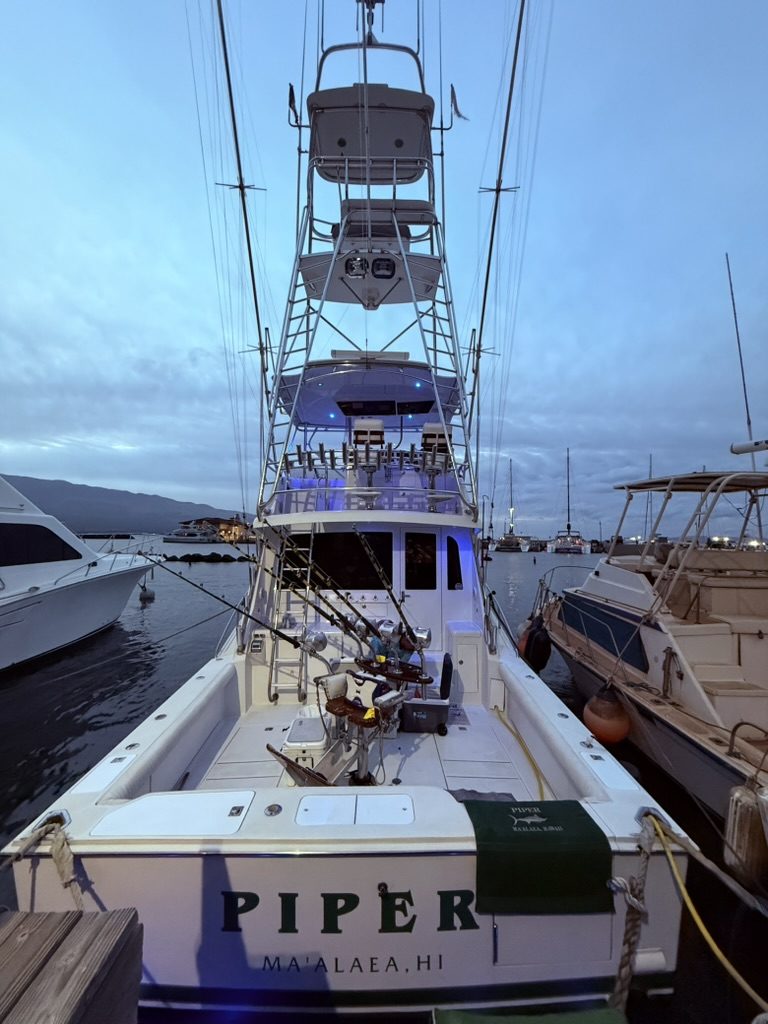
Dawn at Māʻalaea aboard the Piper — check-in comes early, and the marlin don't wait.
Season notes: summer (May–September) is blue marlin and big ahi; winter brings striped marlin, spearfish and steady mahi, with whales alongside. Tip the crew 15–20%. Prone to seasickness? Bottom trips hug calmer water; take meclizine the night before regardless.
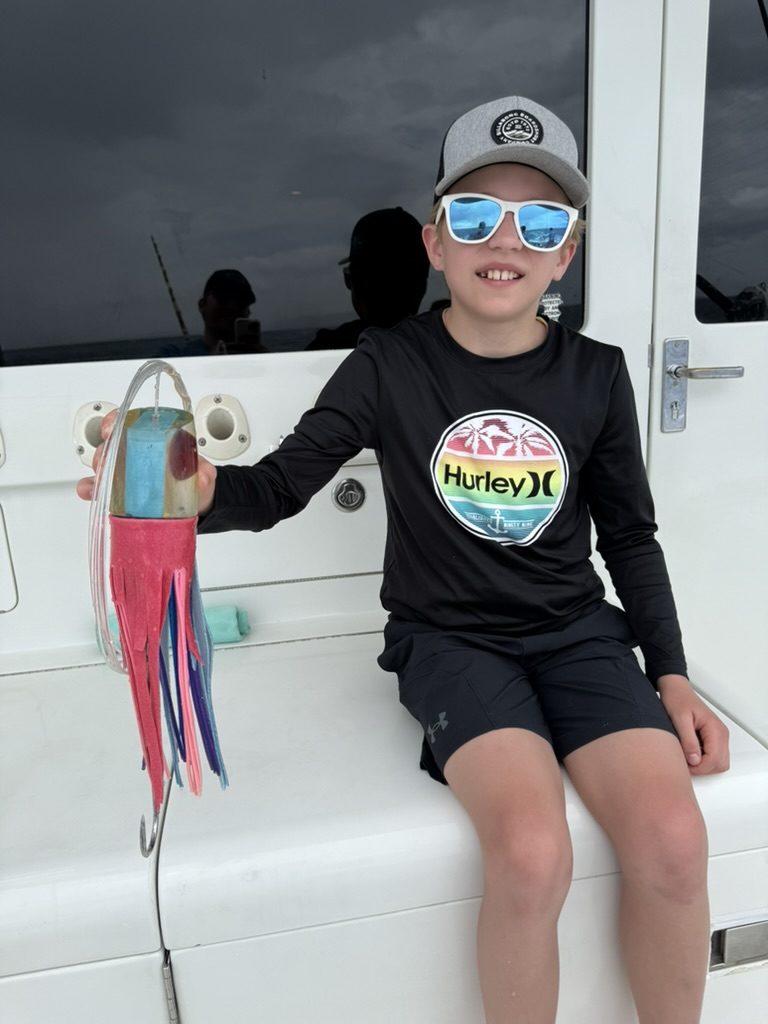
Lure inspector on duty — the charters genuinely welcome kids, and the deckhands make their day.
Do it yourself
Shore fishing like a local
The two local techniques are whipping — casting and retrieving lures on a 7–9 foot spinning rod for papio (young trevally), lai and kaku — and dunking — soaking bait on a long rod with a breakaway sinker rig. Frozen ika (squid) strips from the Times or Safeway fish counter make perfectly good bait; dedicated bait shops are scarce.
Where: the rocky points between Honokōwai and Kahana at dawn and dusk — literally walking distance; the edges of the Māla Wharf area (fish the outside, never among the snorkelers over the sunken pier); and points and drop-offs anywhere the reef gives way to deeper water.
Where not: Honolua Bay is a Marine Life Conservation District — no fishing. And directly out front, Kahekili's herbivore management area protects parrotfish, surgeonfish and urchins — no taking those species along the whole Kāʻanapali shoreline.
Gear:West Maui Sports & Fishing Supply — Lahaina's beloved tackle shop, back home at the Lahaina Cannery since June 2026 — sells and rents rods and will point you to what's biting. Wailuku's Maui Sporting Goods covers spearfishing.
Rules: papio/ulua 10-inch minimum, aggregate bag limits, tako (octopus) 1-pound minimum, moi closed June–August — the DLNR regs booklet is the authority. Spearfishing is legal freediving (no scuba spearing for regulated species); non-residents still need the license.
Etiquette & safety, per the locals
Shore fishing is deeply cultural here. Don't set up beside someone's rods (ulua poles in holders are actively fishing), ask before casting into a spot someone is chumming, watch throw-net fishermen from a respectful distance, and pack out every inch of line. On lava rock: never turn your back on the ocean, and wear tabis or reef shoes. And the ciguatera rule bears repeating — offshore pelagics safe; reef predators like barracuda, roi and big ulua risky no matter how you cook them.
One more thing
Eat your catch
Several restaurants will cook your (legally-yours) catch — Māla Ocean Tavern in Lahaina has a long-running “I caught the fish” program; call ahead with your fillets. There's no fish-shipping service on Maui the way there is in Kona, so the move is simple: eat it fresh, ideally the same night, back at the condo's kitchen or a catch-cooking restaurant. Poke from a fish you fought that morning is a core Maui memory.